Go to Label
Go To and Label are a jump. They pass the message from one point in a flow to another without a wire between them — which is what keeps a large flow readable once the wires start crossing each other.

They come as a pair:
- A Label marks a destination. It has one output and no input — the flow arrives here from a Go To, not along a wire.
- A Go To is the jump. It has one input and no output — the flow leaves here.

Add both from the Flow section of the node palette, or by right-clicking the canvas.
Pointing a Go To at a Label
Select the Go To node and pick the label in its properties. You can select more than one, and the message goes to all of them — a fan-out with no wires. All targets every label in the flow at once.
What it is actually for
Closing loops, mostly. A For Each needs the flow to come back to it after each item, and a wire from the end of the body back to the top of the loop crosses everything in between. A Label at the loop entrance and a Go To at the end of the body says the same thing without the wire, and names the intent:
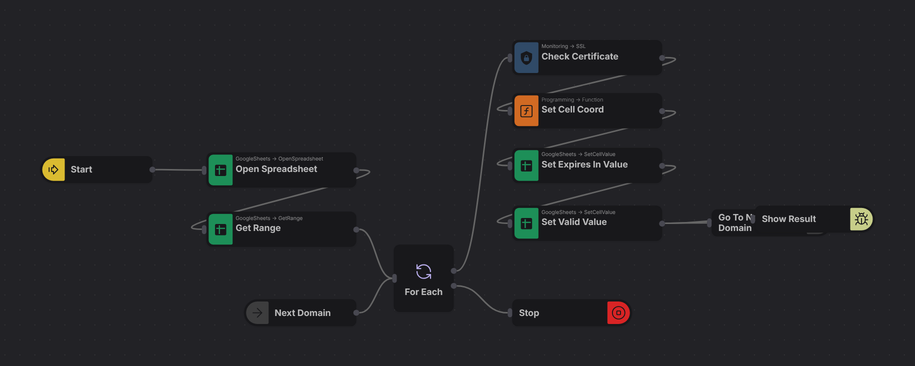
Go To Next Domain → Next Domain. Read the two node names and you know what the jump does,
which is more than a wire tells you.
The other common use is retry. In the Handle Errors template a validation failure jumps
back to a Retry label to ask again, instead of wiring backwards across the flow.
A Go To does not come back. The message continues from the Label and never returns to the Go To — it is a jump, not a function call. When you want something that returns, use a Sub Flow.