Connect Robot
Installing the robot puts the software on your machine. Connecting it links that machine to your workspace, so flows can run on it.
Until this is done the Run button in the Flow Designer stays greyed out, because there is nothing to run a flow on.
If you have not installed it yet, start with Install Robot for your operating system.
1. Open the Robomotion desktop application
Launch it from your operating system's application menu. On first run it has nothing to show you yet:
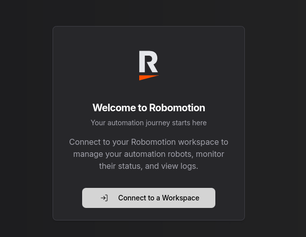
Press Connect to a Workspace.
2. Enter your workspace URL
The workspace comes first, on its own screen.
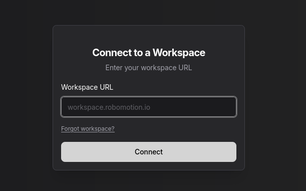
Enter the full address, not just the subdomain:
| ✅ | sparrow.robomotion.io |
| ❌ | sparrow |
Forgotten it? Forgot workspace? will email you the address.
3. Sign in
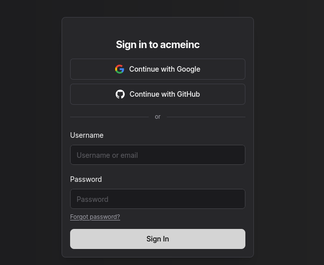
Use the same credentials as the web app — or Continue with Google / Continue with GitHub if your workspace is configured for them. Whichever your workspace uses is what appears here; see Security Model.
4. Pick a robot and connect it
Signing in lists the robots in the workspace.
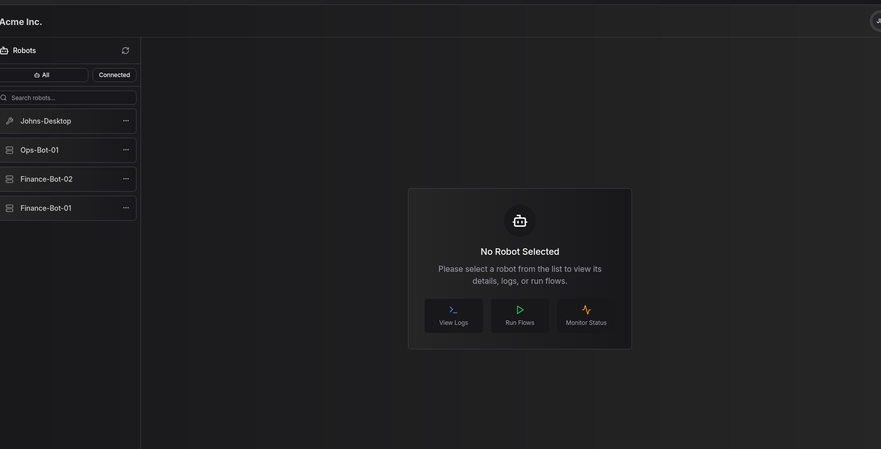
The icon beside each name tells you its type — a wrench for development, stacked bars for production. A new workspace comes with one development robot, which is the one to use while building. See Robot for why the distinction matters.
Select a robot, then connect it. It turns green:
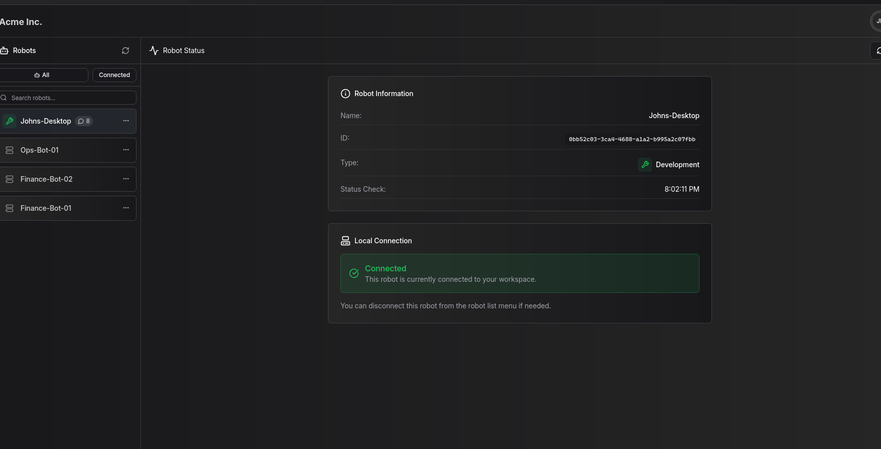
Robot Status then shows its name, ID, type and a live status check, and Local Connection confirms it is attached to your workspace. View Logs and Run Flows are available from here too, which is often quicker than opening the Admin Console.
Verify it
Two places, and it is worth checking one of them:
- Admin Console → Robots should list it as connected.
- In the Flow Designer, the Run button should now offer Desktop.
Connecting without a desktop session
The steps above assume someone is sitting at the machine. For a server — no desktop, no person — use a robot token and the command line instead:
robomotion-deskbot connect -w acme.robomotion.io \
  -r <robot-id> -t <robot-token> --no-attach
Better still, pass the credentials through the environment so the token does not appear in
ps output. See robomotion-deskbot, and
Windows VPS or
Linux VPS for the whole setup.
The desktop application connects a robot, which executes flows. There is also
robomotion-agent, which connects the machine so the
Designer can reach it — that is what the AI Assistant and the Image nodes use. Connecting one
does not connect the other.