Audit
Audit Logs records who changed what in the workspace, and keeps it. Every create, update and delete of a robot, flow, schedule, queue, token, trigger, vault or user lands here, along with the state before and after the change.
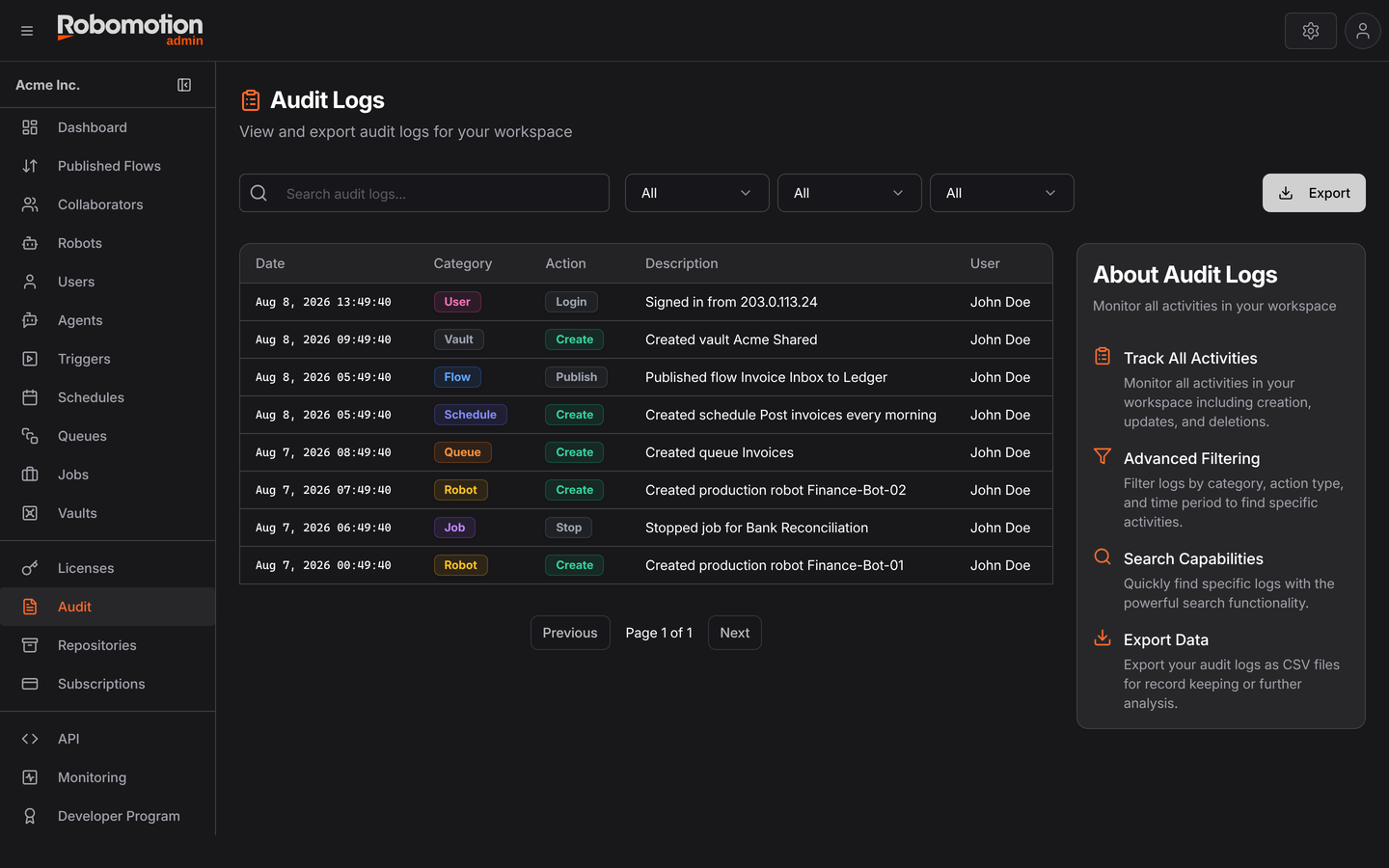
Each row carries the date, a category badge, an action badge, a description, and the user who did it.
Filtering
Three dropdowns and a search box, left to right:
| Filter | Options |
|---|---|
| Category | All, Flow, Job, License, Robot, Schedule, Token, User, Queue |
| Action | All, Create, Update, Delete |
| Time Period | All, 1 Day, 2 Days, 4 Days, 1 Week, 2 Weeks, 1 Month |
Search matches the description text, so it reaches entries the Category dropdown does not offer — vault, trigger, webhook, workspace and authentication events are all recorded and all searchable, they just have no dedicated filter. Search for the resource by name.
Export
Export downloads the current view as CSV — with the filters and search you have applied, not the whole log. The file has five columns: Category, User, Action, Description, Time.
Before and after state
Every entry stores the state of the resource before and after the change. The console does not
render it, but the API returns it — previous_state and next_state on each log from
/v1/audit.logs:
curl -G "https://api.robomotion.io/v1/audit.logs" \
  -H "Authorization: Bearer $ROBOMOTION_TOKEN" \
  -d category=Robot -d action=Update -d size=25
That is the way to answer "what exactly changed on this robot" — the description tells you a robot was updated, the two state objects tell you which field.
What is not here
Audit records changes to configuration, not flow execution. To see what a robot did when it
ran, use Jobs, which keeps each run's status, duration and
logs. The one overlap is the Job category, which records a job being created or updated by the
scheduler.