Packages
A package is a set of nodes. Packages in the Designer's left rail is the catalogue of every one you can add to your workspace.
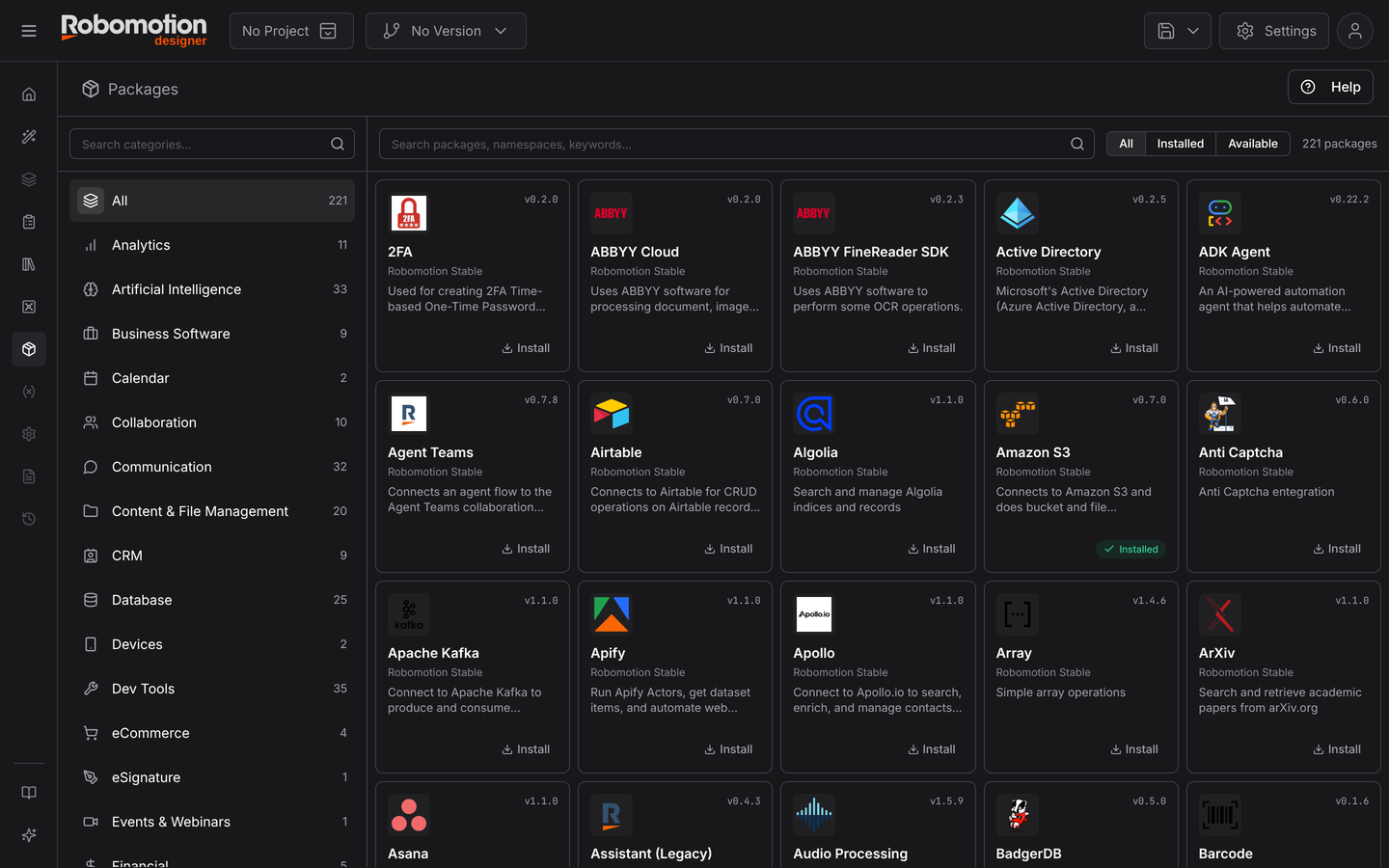
Categories with counts down the left, search across the top, an All / Installed / Available filter, and a card per package showing its version, publisher and a one-line description.
Excel, Browser, CSV, File System, Flow, Mail, Keyboard, Mouse and about fifteen other categories ship inside the robot. They are always in the node palette and they are not in this catalogue — searching it for "Browser" returns nothing, which looks like a bug until you know the split. The catalogue is add-ons on top of what the robot already has.
Finding one
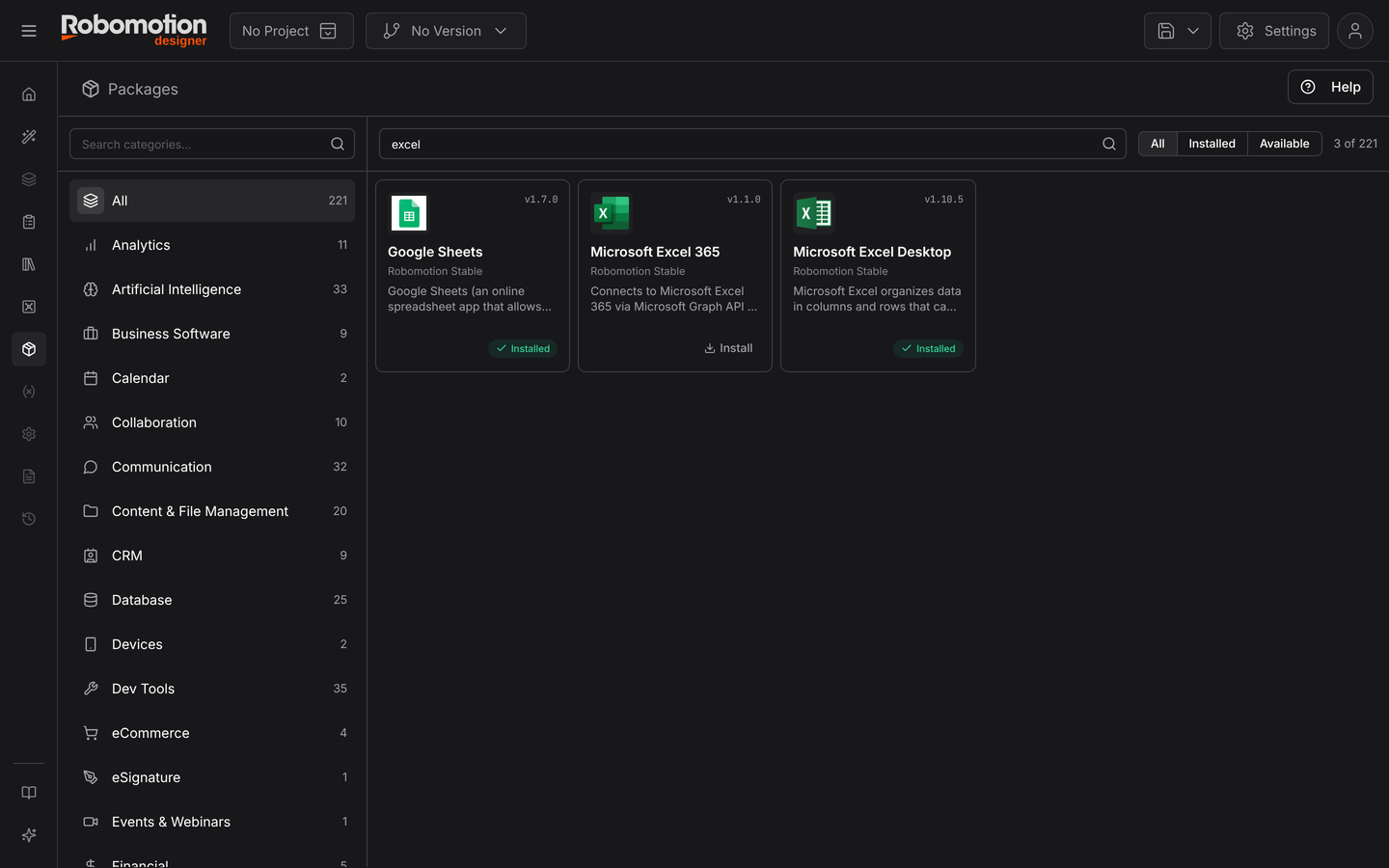
Search matches names, namespaces and keywords, so s3 finds Amazon S3 and sheet finds Google
Sheets:
Or narrow by category in the left column — the counts tell you how much is in each before you click.
Installing
Install on the card. Installation is per workspace, not per flow: once installed, the package's nodes appear in the palette for everyone in the workspace.
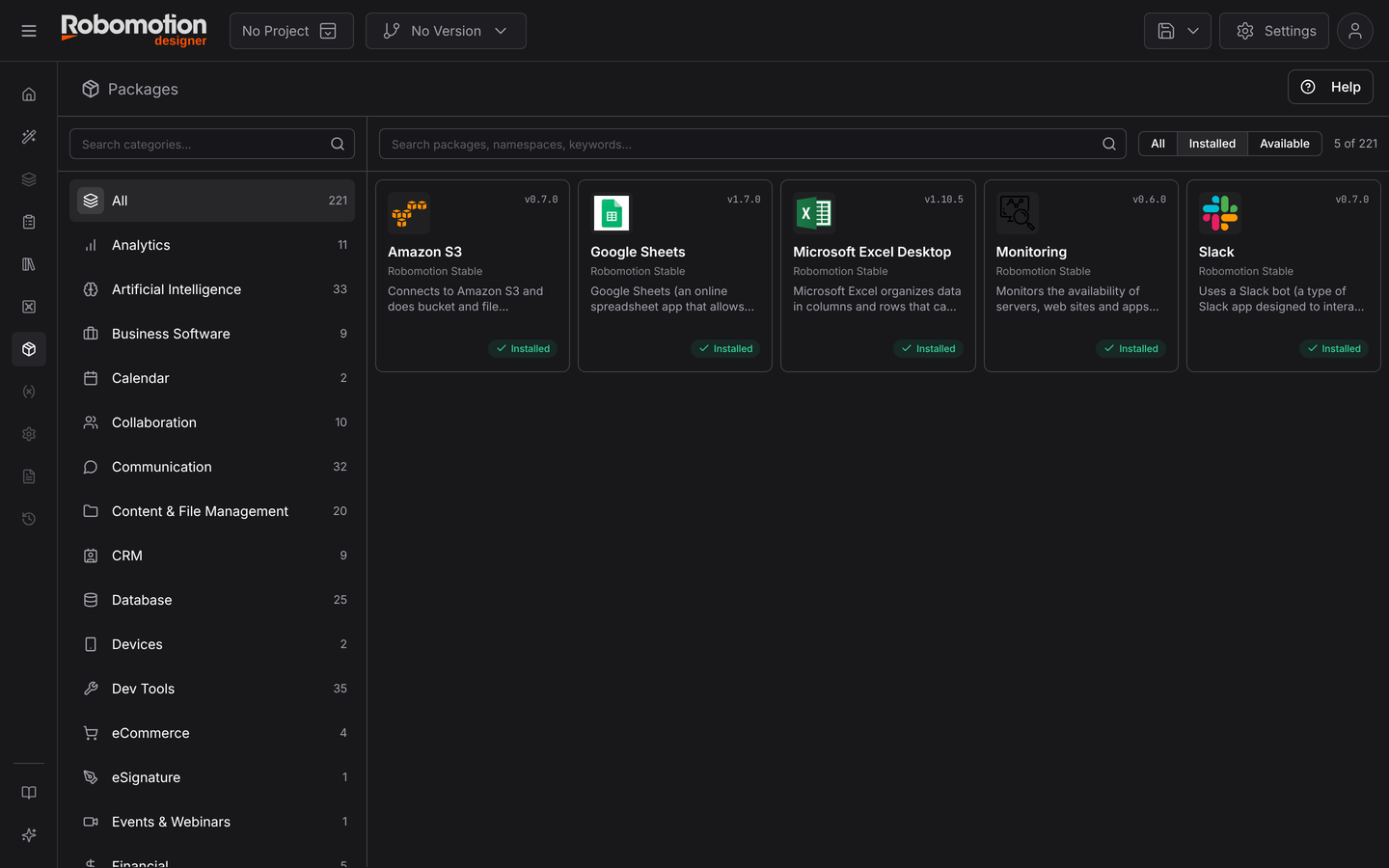
Switch the filter to Installed to see what your workspace already has — and the count next to it, which is the quick answer to "did that install work?":
Package details
Click a card — not the Install button — to open its detail drawer:
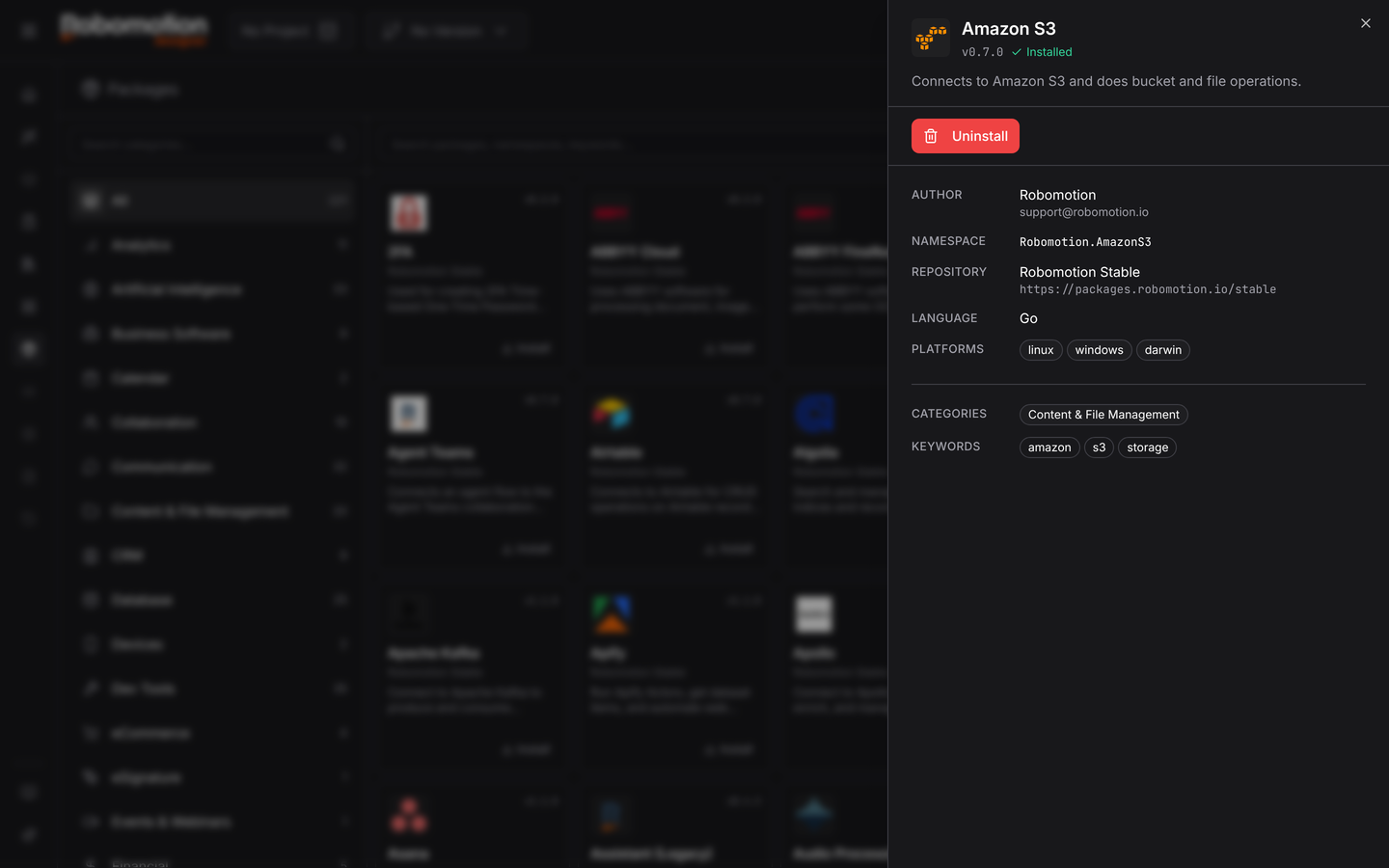
| Field | Why it matters |
|---|---|
| Namespace | What the node's namespace looks like in a flow, e.g. Robomotion.AmazonS3 |
| Repository | Where it came from. Robomotion Stable is the default; a workspace can add its own |
| Language | What the package is written in — Go, Python, .NET, Java or JavaScript |
| Platforms | Which operating systems it runs on. Check this before scheduling a flow on a Linux robot |
| Categories and Keywords | What search matches on |
Uninstall is here too.
A package listing only windows will fail on a Linux robot at run time, not at design time —
the flow builds fine and then the job errors. If a flow is meant to run unattended on a server,
check the platform tags of every package it uses.
After installing
The nodes appear in the node palette on the Designer canvas, grouped by their package's category. From there they drag onto the canvas like any built-in node.
See also
- Package reference — every node in every package, with properties
- Repositories — adding a private package repository
- Robot Development — building a package of your own