Inspect an element
Inspecting fills in one node's selector by pointing at the element instead of writing it.
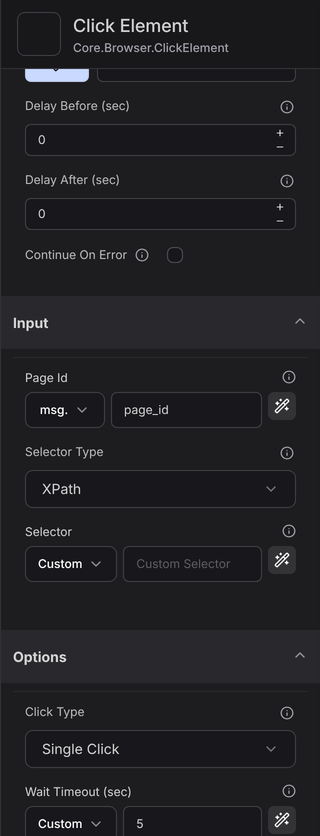
Every Browser node that takes a Selector has an inspect control beside it — the wand icon on the right of the field. Selector Type says how the selector is written (XPath by default), and the scope selector beside it works as it does everywhere: a literal you type, or a value read off the message.
How it goes
- Add the node — Click Element, Get Value, Type Text, whatever the step is — and select it so its properties are open.
- Start Inspect from the selector property.
- The extension takes over the page. Move the pointer and elements highlight under it.
- Right-click the element you want. The extension offers the node actions that make sense for it — Click Element, Get Value, Scrape List, Scroll, Send Keys, Type Text, Sub Flow.
- Pick one, and the selector lands back in the node.
The Designer chooses which inspector to start from the node's namespace, so inspecting from a Windows Automation node opens the desktop inspector rather than the browser one.
What comes back
More than a string. The inspector returns the element's attributes and its hierarchy — the chain of ancestors — which is what lets Robomotion build a selector that survives small changes to the page rather than one tied to an exact position.
A preview image of the element is captured too, and pinned to the node. Reopening a flow six months later, you can see what the node was pointing at instead of decoding an XPath.
Checking a selector
The inspector can test a selector and report how many elements it matches. That number is the thing to look at:
| Matches | Meaning |
|---|---|
| 1 | What you want |
| 0 | The selector is wrong, or the page has not finished loading |
| more than 1 | Too loose — it will act on the first, which may not be the one you saw |
Matched elements are highlighted on the page, so a selector that catches twelve rows instead of one is obvious immediately.
When a page fights you
The element only exists after an action. Open the menu, or whatever reveals it, then start inspecting.
The element is inside an iframe. The inspector handles frames and records the frame path with the selector, so this works — but the flow needs a Switch Frame before the node.
The page rebuilds itself. Single-page apps regenerate class names on every build. Prefer a
selector anchored on something meaningful — an id, a data- attribute, visible text — over one
built from generated classes.
See also
- Record a session — the faster start
- Browser package — the nodes you are filling in
- Automating a browser — the tutorial